
About Skaggs School of Pharmacy & Pharmaceutical Sciences
UC San Diego SSPPS offers students an innovative and flexible curriculum leading to the Doctor of Pharmacy (Pharm.D.) degree, taught by a stellar health sciences faculty in a program closely associated with the outstanding clinical, research and academic programs in the School of Medicine. The steady-state enrollment is 280 Pharm.D. students.
UC San Diego offers pre-eminent health sciences professional education and research opportunities and is ranked among the top research-intensive universities in the nation.
UC San Diego SSPPS students are an integral part of the rich academic and research environment on the UC San Diego campus. Illustrating the interdisciplinary culture, UC San Diego pharmacy and medical students develop a foundation in the biomedical sciences in common classes and shared volunteer community clinical experiences. The Pharm.D. curriculum also includes basic science and professional practice classes on a campus with premier educational programs in chemistry, biology, physics and engineering. The proximity of the UC San Diego Scripps Institution of Oceanography gives pharmacy students the opportunity to consider research in marine pharmacology and drugs of the sea. As the practice of pharmacy and drug development in the pharmaceutical industry delve deeper into genomics, resources such as the San Diego Supercomputer Center at UC San Diego is central to research in pharmacogenomics, computational biology and bioinformatics.
San Diego ranks third in the nation as an engine for the development of biotechnology products. Surrounding the UC San Diego campus are numerous research and development companies devoted to biotechnology and pharmaceutical development, including many developed by or with UC San Diego faculty.
UC San Diego SSPPS provides a broad-based curriculum with strong basic science, a diversity of clinical experiences and the opportunity for independent study in a variety of research and clinical settings. The program has several major components:

.jpg)
.jpg)
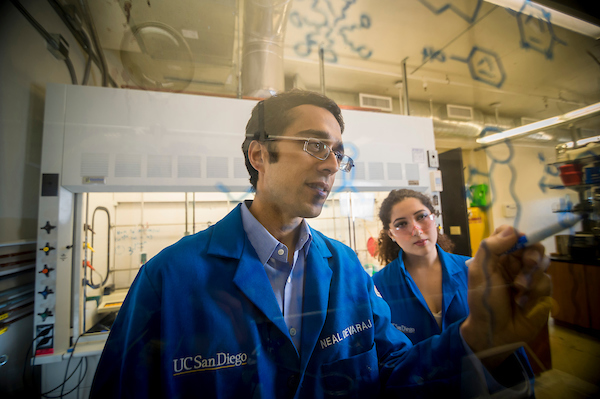
The program leading to the Doctor of Pharmacy degree provides education and training for practice in all environments, today and in the future. These include hospitals, clinics, home care, the pharmaceutical industry and community practice. In small first-year classes, students study the basic and pharmaceutical sciences and the practice of pharmacy. The second year curriculum promotes interactions with medical students as the two groups share classes in the biomedical sciences. Third and fourth year studies apply the knowledge obtained in the basic sciences to therapeutic decisions in the care of patients.
UC San Diego SSPPS recently implemented a seven-year program leading to the award of a B.S. in Chemistry and a Doctor of Pharmacy degree. Students enter as college freshmen, take the sequence of courses required of chemistry-biochemistry majors, and those meeting admission standards enter pharmacy school in their fourth year. The Ph.D. degree program prepares students for research careers in academia, government laboratories and the pharmaceutical and biotechnology industries. The program includes structure-guided drug design, genomics and informatics in relation to therapeutics, pharmaceutics and pharmacology.
Pharmacy practice residencies provide opportunities for Pharm.D. graduates to obtain in-depth clinical experience, teaching experience in the clinical environment and administrative training. Specialty residencies and fellowships allow for highly concentrated research and practice experience in specialty areas of pharmacy practice.
With the increasing complexities of therapeutic management for chronic illnesses, the practice of pharmacy has changed from traditional compounding and dispensing to expanded roles in clinical and therapeutic settings. Today's pharmacist carries significant responsibilities for managing drug information and therapy, educating and counseling patients, monitoring outcomes, and collaborating with industry in the formulation and clinical testing of new biotechnology products.
Health management and retail pharmacy organizations have developed new arrangements where the pharmacist is the therapeutic consultant in the community, serving as the available front-line contact with the public, and overseeing technicians to improve safe and effective drug use and to simplify delivery and distribution of drugs.
The pharmacist has assumed an increasing role as a therapeutic consultant in hospitals, outpatient clinics and home health care settings. Pharmacists are called upon to work with other health care professionals in the therapeutic management of chronic illness, adjusting drug doses, counseling patients, identifying drug interactions, and monitoring and managing therapeutic outcomes.
Good Manufacturing Practices of the Federal Food and Drug Administration encourage pharmacists to be on staff for new drug development and to oversee such functions as formulation, batch testing and sterility within the pharmaceutical and biotechnology industries. Pharmacists are also involved in clinical trial development and monitoring and providing medical information. A major future direction in drug development is pharmacogenomics, the development of therapeutic regimens adapted to individual genetic makeup in order to maximize therapeutic efficacy and minimize toxicity. UC San Diego SSPPS is located on the Health Sciences Campus in La Jolla. The SSPPS building serves as the education and research base for the School and is designed with contemporary computational and informatics facilities and connections to clinical sites throughout the state. Clinical teaching facilities include UC San Diego affiliated teaching hospitals, outpatient clinics and other institutions in the San Diego area.